
Aside from the comical names of some of the athletes, there’s another Olympic topic that I’ve been wanting to blog about for the past week, but never really got around to. That topic has to do with the controversy over the ages of some of the female Chinese gymnasts.
In case you’re completely out of the loop, to compete in gymnastics at the Olympics, you have to be at least 16 years of age, as of some time within the year of the competition. So if you’re fifteen when the Olympics start, that’s okay so long as you’ll turn 16 some time before the end of the year.
 Chinese gymnast Yang Yilin Chinese gymnast Yang Yilin |
The controversy has to do with the fact that it is suspected that up to as many as three of the women on the Chinese gymnastics team are well under the specified age of sixteen. Those three gymnasts are He Kexin, Yang Yilin, and Jiang Yuyuan. All three girls’ government-issued passports conveniently place them at precisely the age of sixteen. This contrasts against ages listed on many previous official gymnastics competition documents, as well as multiple newspaper articles from the past several years. And in the case of one girl in particular, a video has surfaced containing an interview with one of the girls which was recorded last year where she states specifically that she’s only fourteen years old. The video was made by state-sponsored Chinese television. |
Perhaps most condemning of all, however, is a set of documents that only just surfaced earlier this evening – Mike Walker, an American Internet expert, managed to find cached documents from a Chinese government server for the General Administration of Sport of China. (There’s a great Times article about it here.) These documents are government-created forms listing athletes’ vital information, but most importantly, their birth dates. And in the case of He Kexin, it lists her birthday as January 1, 1994, meaning that as of this year, she would be only 14 years old. Most interesting of all, however, is that these documents were deleted recently from those official Chinese government servers – they were only tracked down thanks to the cache of a Chinese search engine.
Before the discovery of those documents, the Chinese government had been insisting that any discrepancies in age found in previous interviews, newspaper articles, and so forth, were due to mistakes on the part of the journalist. As for the video interview, because it was a video found online, the governing body of international gymnastics – the International Gymnastics Federation – stated that the Internet wasn’t a reliable source of evidence. That makes little sense, however, since the Internet didn’t force the girl in question to say on camera how young she was as of last year.
That is of little consequence, however, as now that these government documents have surfaced, the International Olympic Committee has finally decided to step in. They’re now putting some pressure on the IGF to continue their investigations into these discrepancies.
| All I can say is, it’s about damn time! Even aside from how obviously young so many of these girls are, there’s also the fact that the three girls in question have barely had any experience on the international competitive level. Normally by sixteen, gymnasts will have had a fair bit of experience on the international circuit. That’s at least one obvious red flag. The other red flag, of course, is how freakishly young they look. | 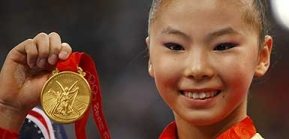 Chinese gymnast He Kexin Chinese gymnast He Kexin |
Naturally, given the differences in ethnicities, the Chinese gymnasts have always tended to look young when compared to their American competitors. So forget trying to compare the girls to our gymnasts! Instead, just compare the three Chinese gymnasts in question to their own team mates. Take, for instance, He Kexin, the gymnast referenced in those unearthed government documents. Compare her to Cheng Fei, the known-20-year-old captain of the Chinese team. When watching Fei compete, you can see the mature composure with which she competes. You see those same qualities in the other gymnasts from around the world of comparable age. You know she’s 20 years old, you can see it in her face and in her composure. He Kexin, on the other hand, bounces around with the fearlessness of a child. Could that be, perhaps, because she still is a child? As the US team’s coach, Martha Karolyi, has noted, she’s even seen one of those three gymnasts in question with teeth missing – at least one of them is still losing their baby teeth! Now think back to when you were 16, were you still waiting for your adult teeth to grow in? I think not.
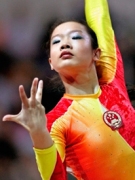 Chinese gymnast Cheng Fei Chinese gymnast Cheng Fei |
All in all, it doesn’t take a genius to piece all of this information together and realize that there’s been some fudging of the rules going on in the Chinese team. With as much pressure as China is under to perform, is it really so shocking a prospect to imagine that perhaps the government has falsified the passports of their star gymnasts? Now really, how hard would that be for a country that controls the Internet access of its citizens, limits the number of children is citizens can conceive, and controls every other aspect of the lives of each and every person within its borders? Is it really that much of a stretch to think that perhaps China wouldn’t think twice about bending the rules in order to prove to the world how superior they are through the medal count at the Olympics? |
So if all of the pieces of this ridiculously obvious puzzle get put together and it turns out to be true that the ages of three Chinese gymnasts were falsified, what should be done about it? I believe the only concievable, fair option is to remove their medals. Not just gold, but silver and bronze as well. Why? Because those are the rules. This isn’t about the feelings of those young Chinese gymnasts, this isn’t about medal counts, this isn’t about one nation proving something to another nation. This is about rules. Rules ensure an even playing field, they ensure the safety of every athlete involved. Rules are a necessity of sport, for without rules there is no sport at all. If China violated the rules of the competition, they do not deserve the glory of the win. End of story.
As for those who – like gymnastics coaching legend, Bela Karolyi – who believe that the age limits should be abolished, I can’t say I completely agree with that. After all, this age issue with the Chinese gymnasts isn’t just raising questions about the International Gymnastics Federation’s ability to enforce their own rules, it isn’t just about the credibility of the IOC and the Olympics at large. This also raises questions about the training tactics of the sport and the insane conditions some of these athletes are subjected to. The question of age limits should be shining just as bright a light onto this aspect of the scandal as anything else, because these are questions that desperately need answers.
One particular example of this goes back to the 20-year-old captain of the Chinese womens gymnastics team, Cheng Fei. During the competition, there are always those heart-warming little vignettes that introduce the viewers to the athletes. There was one of those about Cheng Fei, and despite all of the swelling music, picturesque scenes, and cliches about determination, by the time that video was over, I just about wanted to cry.
In China, gymnasts aren’t introduced to the sport in the same way they are here in America, or like in most other countries. I can speak from experience on this issue. When I was a kid, I was inspired by some of the athletes I saw during the Olympics – I decided I wanted to give gymnastics a shot. At the age of eight, I wandered into a gym in Vicksburg, Mississippi, and I started training. I trained because I loved it, because I wanted to succeed. Obviously, that didn’t work out – my body had other plans. But the important part of this story is that I had the freedom to start training, but just as importantly, I had the freedom to stop.
Back to Cheng Fei. Like most Chinese gymnasts, she was chosen by the age of three. She was picked out of her preschool class because of her flexibility, fearlessness, and bouncy tumbling. She was taken from her family to a far away city, to live in a gymnastics school. This wasn’t her dream, she didn’t decide at the age of three that her dream was to win a gold medal in gymnastics at the Olympics. She had no choice – she was raised into it, not because her parents wanted it for her, but because the government saw in her a raw physical ability that they chose to manipulate.
|
What was so particularly heart-breaking about Cheng Fei’s vignette was that she wanted to stop. Several times throughout her childhood, through her teenage years, up until about a year before the Olympics, she wanted to stop. She would call her parents, begging them to let her come home. But because she was their ticket to a decent meal and a roof over her head, her parents were forced to turn her away. And what reward does Cheng Fei have to look forward to now that she has won her country a gold medal at the Olympics? Finally, after 17 years away from her family, she can finally see the house that her parents live in. Can you even begin to imagine that?
I’m sorry, that’s no longer sport, that is servitude. When any athlete wants to quit, they should have the right to quit. When a child wants to go home to their parents, they should have that right. When a child is forced into that situation and denied the right to stop, she no longer has any rights and is a slave to the government. |
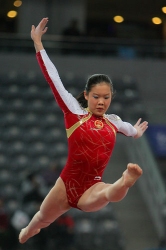 Cheng Fei, age 20 Cheng Fei, age 20 |
That is part of what this age limit is about – it’s about discouraging those governments who abduct children and train them so hard, so young, that they peak by the time they are thirteen and fourteen years old. Because when children are trained the way they are in the Chinese system, their bodies reach the height of their gymnastics abilities well before their sixteenth birthday. That also means that their growing bodies are significantly harmed. The longer they keep training, the more damage is does to them. And that’s just the physical aspect; that doesn’t even begin to delve into the unimaginable abuse to the hearts and minds of those children.
Age limits – like the one at these Olympic games – serve as a safeguard against systems like that of China. If the age limit is there, the hope is that the training will adjust to conform to the hope that the athlete’s abilities will peak at the age of sixteen. That also evens the playing field for those other countries who actually seem to care about the long-term well-being of their athletes, who don’t steal children from their families and force them into intensive and dangerous training. If that age limit is removed, then it only serves to uphold the training methods of the Chinese, because they will then continue to dominate competition with their younger athletes, leaving little to no hope of success for those who actually went about their training in an ethical manner. The athletes themselves get hurt, the competition is devalued, and everyone loses.
 Jiang YuYuan, China Jiang YuYuan, China |
Losing a gold medal is never a good feeling, and believe me, my heart goes out to the athletes on the Chinese gymnastics team. But my empathy for them in that regard doesn’t even begin to compare to the sadness I feel for them for the childhoods they’ve lost, for the families they don’t know, for the pain they’ve endured, and the freedoms that were denied them. A gold medal obtained through broken rules and unethical training practices will never make up for what was stolen from them. The only way we can keep that from happening to another generation is to deny China the honor of the medals they received through their duplicitous and dishonest methods. |
Finally, if the International Gymnastics Federation and the International Olympic Committee do nothing to uphold their own rules and standards of competition, then there is no hope for maintaining the fair and credible atmosphere of the Olympics. The very spirit of the games will be tarnished and their reputation lost. Because if rules cannot be upheld in sport, there is no sport at all.
Update: 08/22/08, 9:35PM: After reading Mike Walker’s blog, I’ve decided to jump into the situation head-first. In his blog, Walker requested that others save copies of the cached documents and host them on their own servers, creating a kind of international secondary web archive in the event that China attempts to delete these cached files from Baidu’s servers. Answering the call, here are my own hosted copies of the two cached files: one & two.
Have I told you lately how much I adore the internet? Here’s hoping the hackers, geeks, and nerds of the world can serve to keep governments honest.
Update: 08/24/08, 12:57AM: Mike Walker has posted word on his blog that the original cached files have been deleted from Baidu. It appears I was able to copy them at the very last second. It’s up to you to determine for yourself, why were these files deleted, and by whom? Was their time nearly up on the regularly scheduled clearing of cached files, or is there something more sinister at work here? After all, it’s not like we should be surprised by any of China’s attempts to manipulate information, both amongst their own population and throughout the rest of the world – we only need remember the SARS scare from a few years ago for evidence to that fact.
Mike also links to a brilliant dossier of evidence compiled by The Huffington Post, clearly illustrating He Kexin’s 1994 birth date. Check it out for yourself. All of their evidence was collected from state-run news sources in China, all of which have since been either changed or deleted.
Now to end this update on a slightly more light-hearted note. Out of all the news articles I’ve read about this controversy, the Los Angeles Times wins for the most creative – and most theoretically accurate – idea for determining the ages of the gymnasts in question: forensic X-ray analysis. Now there’s something no government could manipulate! Check out the article.
It’s rather funny that the U.S. are claiming to be the #1 in the Beijing Olympic Game when the rest of the world count how many GOLD MEDAL instead of the total medal.
And even funnier is that the U.S. media has been ranking by number of gold medal instead of total medals.
Isn’t the U.S. trying on the edge to prove that U.S. is superior than the rest of the World or China?
Emma – did you even read the blog entry before commenting? If you did, you’d know already that none of this has anything to do with medal counts. I couldn’t care less which country ends up with more medals, because I don’t look at the Olympics as a political vehicle for proving national superiority. I see it as a true international athletics competition, where the best in the world come for an honest fight to determine which individual athlete has put more effort, more dedication, more heart, and more honesty into their training. Politics has nothing to do with that, politics doesn’t lead to better athletes.
In this situation, the athletes may have been superior – I never once doubted the talents of the young Chinese gymnasts. But the problem is, they broke the rules. It doesn’t matter how good they were, because they weren’t eligible to compete. Those are the rules of the sport, and if those rules are not upheld, then the competition is pointless. Without rules, sport isn’t sport anymore. Without those rules, the Olympics truly will be reduced to nothing more than pointless politics.
Remember, this gymnastics competition wasn’t just between the US and China – there were other countries competing too. The athletes from those countries were also cheated out of their chance to compete by China violating the rules. Everyone else competed according to the rules, China didn’t. Medals have nothing to do with that. If you really want to complain about this being about politics, then China is the one to blame here. They stopped this from being about sport and turned this into nothing more than ridiculous political grandstanding. It’s the responsibility of the governing bodies of gymnastics and the olympics to protect the integrity of the athletic competition by doing everything in their power to protect the rules AND the athletes from the political aims of nations. If those rules cannot be upheld, then the Olympics are truly pointless.
No, sorry i didn’t read your whole entry. Just like, you wouldn’t have looked up every single article written about this issue – on both sides- before you wrote your entry, correct?
Regardless if China has actually broken the rules. I really wonder if anyone would make such a big deal out of it if China wasn’t winning. There has been people criticizing China had put children on the Olympic games before, in Athens, Sydney. And not only China has been doubted, but other countries, like Romania..
The whole reason why it’s such a big deal right now, is because China has been doing so well in this game. International events like the Olympics always involved politics. And politics can’t just be happening with only one side.
Plus, if the age problem has been brought up before, then obviously, international-wise, people have been ignoring the problem and try not to deal with that. If that’s the case, maybe people should find out why no one cares about investigating it up until now.
Actually, yes, I have read a multitude of articles from both sides – that’s why it took me several weeks before writing this blog. I could have jumped the gun and written about it back in June when this first came up, I could have written about it when the Olympics started. But I didn’t, because I didn’t want to write about something that was just speculation. But at this point, in my opinion, too much evidence has come forth, pushing this beyond just allegations. So yeah, I’ve read articles from each and every side, whereas you can’t even read an entire blog entry before commenting on it. You’re talking without getting the full story.
It’s also quite apparently clear that you don’t even understand the full history in gymnastics that’s led up to this current scandal. The ages of gymnasts have never been ignored, otherwise why would the age limit be there in the first place? If no one cared that Romania, Russia, and other former Soviet powers used the same practices as the Chinese, then there’d be no age limits at all. Yes, I am fully aware that the former Soviet Union used these same tactics. Yes, the rest of the gymnastics world is aware of that too. But they were forced to face the consequences of that behavior – when those age limits were put in place, it was to prevent them from continuing those practices. They stopped those programs, but unfortunately China did not. China decided to instead find ways around the regulations, and that’s where we are today.
Nothing has been ignored, and if you knew anything about gymnastics, you’d realize that’s how we’ve gotten to where we are right now. The reason there’s been such a slow boil with China is that before – in Sydney, Athens, etc – there was only suspicion, but never any evidence. This time, there’s evidence, and that’s precisely why this cannot be ignored.
In fact, if you’re so angry about things supposedly being ignored before, shouldn’t you be thrilled that it’s not being ignored now? Bottom line is, it’s never been ignored; those age limits are there because of the abuses that happened in the former Soviet powers. They faced the consequences and changed their ways. China has fought the system, sneaking around it in so many ways, to the detriment of their athletes. Now that we have solid proof that they’ve been violating the rules, it’s in the athletes’ own best interests to force China to face the consequences of their rule-violating behavior. Maybe then they’ll realize that abducting children and forcing them into training programs isn’t the best way of raising gymnasts.